Last updated May 2026
Difficult Conversation Statistics:
the cost of silence
FACTS and data behind DIFFICULT CONVERSATIONS at work
Research and figures to help understand the risks of avoidance in workplace conversations. Why we need to handle conversations more confidently, to grow cooperative and productive cultures.
A reference resource for leaders, HR professionals, managers, journalists and researchers exploring the impact of unresolved workplace conversations.
1. Avoidance
The most common problem is avoiding or delaying difficult workplace conversations in the first place. It just makes it worse. Once put off it’s hard to re-instigate it, often seeming harder. And this is happening at all levels.
Only
24%
of employees directly confront
challenging situations
"47% of employees' most common response to conflict is simply to 'let it go'."
Source: CIPD Good Work Index, YouGov survey 2024
"43% of respondents estimate they waste two weeks or more ruminating about an unresolved problem at work." "One in three employees estimates their inability to speak up in a crucial moment has cost their organisation at least $25,000."
Source: Crucial Learning (formerly VitalSmarts), 2021 (follow-up to 2016 study)
"Only 24% of employees report directly confronting challenging situations."
"34% of managers and employees have postponed a difficult conversation for a month or more. 25% have deferred one for a year or longer."
Source: Atana (citing multiple studies)
"72% of respondents reported instances where they or others failed to speak up effectively when a peer did not pull their weight. 68% reported a failure to address disrespect."
Source: VitalSmarts (now Crucial Learning), Costly Conversations study, 2016.
"70% of employees avoid difficult conversations with their boss, colleagues, or direct reports."
Source: US Study by Bravely (professional coaching platform) CNBC Make It March 2019; & Inc. 2018.
"53% of employees handle 'toxic' situations by ignoring them."
Source: Bravely, as above, via Inc.
The chances are that these figures are actually much higher, and resulting in poor performance, drop in respect, over-functioning and burnout of capable people, resentment and an underlying toxicity.
Every time a leader says they need accountability, initiative and clear communication from teams, they almost always need more direct conversations and the gateways to stop the costly avoidance. Not doing so literally throws money down the drain and people under the bus.
Putting it off erodes trust because rarely does the conversation partner NOT know it’s needed. We need to make it easier to have conversations at work and not create a professional excuse to avoid them.
2. COST and
BUSINESS IMPACT
We give reasons why not to have the difficult conversations at work but the risks of not having them are why we should make them a priority. Being off work with mental health issues has often resulted from the lack of the right, timely conversation:
a difficult conversation
not held
costs $7500
and more than
seven
work days
"The cost of workplace conflict to UK organisations is in the region of £28.5 billion — equivalent to more than £1,000 for each employee. Close to 10 million people experience conflict at work each year, with more than half reporting stress, anxiety or depression as a result."
Source: Acas, Estimating the Costs of Workplace Conflict, 2021
An estimated 485,500 employees resign each year as a result of conflict. There are an estimated 374,760 formal grievances each year — costing an average of £951 in management time each. Approximately 1.7 million formal disciplinary cases are held each year. The number of employees dismissed each year is around 428,000 — resulting in £13.1 billion in recruitment and replacement costs."
Source: Acas, as above.
"The total cost of management time spent dealing with potential and actual litigation is estimated at £282 million each year, with a further £264 million spent on legal fees."
Source: Acas/Trowers & Hamlins, 2021
"Workplace conflict costs organisations almost three weeks of lost productivity per employee per year."
"US employees spend 2.8 hours per week involved with conflict, amounting to approximately $359 billion in paid hours — the equivalent of 385 million working days."
Source: CPP Inc. Global Human Capital Report via Workplace Peace Institute (updated, but includes $ figs from 2008)
"Every difficult conversation not held costs an organisation $7,500 and more than seven lost workdays."
Source: VitalSmarts (Crucial Learning), 2016 study, cited by Atana
Keeping the peace is having the opposite effect. A work conversation that could have taken five minutes costs extra time spent on underlying tension, whether it’s a delayed tasks, venting or the side-effects of unspoken pressure.
The cost of conflict really reflects unresolved conflict. Conflicting opinions are positive for business improvements, but when it’s personal and left to go sour then it’s risky. By the time it escalates the costs are no longer relating to lost hours or lost goodwill, they’re now HR, legal and recruitment time and fees.
Many issues escalate just because the person didn’t feel heard. What may have started as a minor problem turns into wanting payback. Leaders need to know that work conversations that seem impossible are in fact possible.
3. LEADERSHIP
and MANAGEMENT
BEHAVIOUR
Workers need to feel safe and valued. Someone having their back and capable of straight-talking is a necessity, not a nice-to have. People lose respect for leaders who can’t handle the hard talks, because if they don’t then who will?
Nearly
25%
think their managers
handle conflict poorly
or very poorly
"Nearly half (49%) of emerging manager candidates fail to demonstrate effective conflict management skills. Only 12% show high proficiency. Only 30% of leaders express confidence in their ability to manage conflict."
Source: DDI (Development Dimensions International), assessment, 2024
"61% of manager candidates struggled with clarifying core issues in conflict. 65% demonstrated difficulty offering support and resources to their team."
Source: DDI, as above.
"Managers now spend over 4 hours a week dealing with conflict on average — time spent on conflict has doubled since 2008. Over a third (36%) of people deal with conflict often, very often, or all the time, up from 29% in 2008. Nearly 1 in 4 people think their managers handle conflict poorly or very poorly."
Source: The Myers-Briggs Company, Conflict at Work research, 2022
"57% of employees have left a job because of their manager. 14% have left multiple jobs because of their managers. A further 32% have seriously considered leaving because of their manager. Senior leaders say the top weakness of frontline managers is their ability to have difficult performance conversations."
Source: DDI Frontline Leader Project, 2019
"82% of workers entering management positions have not had any formal management and leadership training — the UK's 'accidental managers'. One in three people have left a job because of a negative work culture. Half of those with ineffective managers plan to quit within the next year."
Source: Chartered Management Institute (CMI) / YouGov, Better Managed Britain report 2023
"Two-thirds of US and Canadian employees want to have tough conversations at work — but one in three feel unsafe having them with their manager. Only a quarter of managers have received sufficient training on having hard conversations. Less than one-third of employees say they trust their managers."
Source: Achievers Workforce Institute (AWI), Getting Comfortable with the Uncomfortable at Work Report, 2024
People don’t generally go to work intending to do a bad job. Most managers feel ill-equipped to handle the tough talks required in their roles. They’re normally promoted for technical competence, not management skills, and it can easily become something to cover up or feel overwhelmed by.
When managers aren’t capable their teams sense it because it becomes unclear very quickly, whether there are time lags, waffle or excuses. 61% can’t identify the core issue in conflict. Suddenly the only consistency is meaningless management speak.
Most managers don’t get formal training. But they need to learn that having difficult conversations can be caring, safe for them and staff and a leadership quality that commands respect. Difficult work conversations aren’t a failure but an opportunity to fix something, without a script, and with sincerity.
4. Human resources
/ORGANISATIONAL
CULTURE
Systems aren’t set up for workers to feel safe and managers are generally ill-equipped to suitably motivate and manage people as individuals. HRs are often expected to deal with what managers should be handling:
employees
who experience
conflict are
twice
as likely to
consider leaving
within 12 months
"81% of employers believe they are doing enough to prevent and manage bullying and harassment — but only 36% of employees who experienced conflict in the past year feel it has been fully resolved. 70% of employers say their organisation has effective procedures for resolving interpersonal conflict."
Source: CIPD, How employers are tackling bullying and harassment at work, 2024
"A quarter (25%) of UK employees — an estimated 8 million people — experienced workplace conflict in the past year. The most common forms: being undermined or humiliated (48%), being shouted at or in a heated argument (35%), verbal abuse or insult (34%), discriminatory behaviour (20%)."
Source: CIPD Good Work Index/YouGov, 2024
"Employees who experienced conflict were significantly less likely to be satisfied (54% vs 77% without conflict) and twice as likely to consider leaving within 12 months (33% vs 16%)."
Source: CIPD as above
"44% of working-age adults in Great Britain experienced conflict at work in the last 12 months — the highest level ever recorded. The most common conflict topic: capability and performance (38%). Most frequently with line managers (32%) and colleagues (34%).
Source: Acas, How prevalent is individual conflict at work in Great Britain in 2025?
"Companies with a healthy corporate culture report, on average, a turnover rate of 13.9% compared to 48.4% at companies with a poor culture."
Source: Columbia University study (2012)
Procedure doesn’t trump culture. People stay where they feel safe and they’re productive where they know they matter more than a process. If not, then everything else drops (honesty, innovation, accountability, trust) whilst turnover rises quickly.
These factors don’t show up in a staff survey, can’t be fixed by a change in strategy or an awayday. Most people don’t quit over a one-off, but repeated frustrations. Performance is THE topic of discontent. A lack of straight-talking means underperformance is left undealt with, whilst top performers are left to carry the load unfairly.
Consistency is key. Being well-treated on a regular basis looks like routine 1:1 meetings, how feedback is delivered, how fair the expectations are and whether they’re clear for everyone. The test is how things are handled, when a work conversation is emotionally charged, and this is a learnable skill not a personality trait.
5. CONFLICT
ESCALATION &
RESOLUTION
What goes unsaid does a lot of damage. Those issues that linger, cause friction, and leave a bad taste in the mouth are the liabilities. We need more workplace conversation skills, not just a formal process for when it’s turned ugly. What starts internally reflects externally:
68%
said that the most
crucial
conversation
consistently avoided
is when someone isn’t
pulling their weight
"44% of workers say workplace conflict has increased in the last 3 years; only 13% say it has decreased. Top causes: pay (25%), working patterns (22%), capability and performance (20%)."
Source: Acas-commissioned YouGov poll, 2025
"Half of people who reported experiencing conflict stated it was largely or fully resolved. People most commonly resolved conflict through discussion — with their line manager (45%) or informally with the other person (30%). Less than 10% took internal formal action. Under 0.5% filed an employment tribunal claim." "Over half of people who reported conflict (57%) experienced stress, anxiety or depression as a result."
Source: Acas, prevalence of conflict report, 2025
"The number of employment tribunal claims has increased by 185% since 1979 — from around 41,000 to around 115,000 in 2024."
Source: Acas, as above
"The top five crucial conversations people consistently avoid: when someone isn't pulling their weight (68%), when someone performs below expectations (66%), when someone shows disrespect (57%), when someone doesn't follow proper processes (53%), when there is confusion on who owns a decision (53%)."
Source: Crucial Learning, 2021
Workers have more rights and higher expectations than before and they experience increasing conflict. Most people want a conversation, fairness, clarity, acknowledgement, and change and attempt to resolve things informally and with their manager directly. If they’re safe to.
However, many workplaces don’t feel like safe enough places to be honest. So this is where it spills over into home life, anxiety and stress, time off and planning an exit. The most crucial avoided conversations (around poor performance, lack of accountability, disrespect, unclear ownership and process failures) lead to working in silos, office politics and downward shifts in customer service.
Underpinning it all is fear of the consequence of a conversation that hasn’t happened yet. Learning how to make a difficult workplace conversation safe is the starting point.
6. Quick-reference
research
summary:
| Statistic | Source | Year |
|---|---|---|
| 44% experienced conflict in last 12 months — highest ever recorded | Acas | Nov 2025 |
| 57% experienced stress, anxiety or depression as a result of conflict | Acas | Nov 2025 |
| 44% say workplace conflict has increased in the last 3 years | Acas / YouGov | Aug 2025 |
| 81% of employers think they handle conflict well — only 36% of employees agree | CIPD | 2024 |
| 25% of UK employees (8 million) experienced conflict in the last year | CIPD Good Work Index | 2024 |
| 47% of employees simply let conflict go unaddressed | CIPD | 2024 |
| 49% of emerging managers fail at conflict management | DDI | 2024 |
| 82% of managers have no formal training — "accidental managers" | CMI / YouGov | 2023 |
| 4 hrs/week managers spend on conflict — double the 2008 figure | Myers-Briggs | 2022 |
| 1 in 3 estimate their silence cost their organisation £25,000+ | Crucial Learning | 2021 |
| £28.5bn annual cost of workplace conflict to UK employers | Acas / Sheffield / Westminster | 2021 |
| £1,000 per employee per year lost to workplace conflict | Acas | 2021 |
| 485,500 resignations per year in the UK attributed to workplace conflict | Acas | 2021 |
| 57% of employees have quit because of their manager | DDI | 2019 |
| 70% of employees avoid difficult conversations at work | Bravely / CNBC | 2019 |
| $7,500 + 7 days average cost of each failed conversation | VitalSmarts / Crucial Learning | 2016 |
| $359bn lost annually to workplace conflict | CPP / Myers-Briggs | 2008 |
7. frequently
asked
questions:
-
Yes. The Myers-Briggs Company found that time spent on workplace conflict doubled between 2008 and 2022. Acas's most recent prevalence survey (November 2025) recorded the highest ever level of individual conflict at work in Great Britain. A YouGov poll commissioned by Acas in August 2025 found that 44% of workers say conflict has increased in their organisation over the last three years, compared to just 13% who say it has decreased.
-
According to Acas, workplace conflict costs UK employers £28.5 billion every year — the equivalent of just over £1,000 for every employee in the UK. The largest costs are associated with resignations (£11.9 billion annually) and disciplinary dismissals (£10.5 billion).
-
Research by professional coaching platform Bravely found that 70% of employees avoid difficult conversations with their boss, colleagues, or direct reports. Of those, 53% deal with difficult situations by ignoring them entirely, and only 24% report directly confronting challenging situations.
-
Considerable. Acas research found that more than half of the nearly 10 million UK employees who experience conflict each year report stress, anxiety or depression as a result. CIPD data shows that employees experiencing conflict are more than twice as likely to always or often feel exhausted (42% vs 18%) and more than twice as likely to always or often feel under pressure (37% vs 15%) compared to those who report no conflict.
-
Research by VitalSmarts (now Crucial Learning), based on a study of 1,025 people, found that every failed or avoided crucial conversation costs an organisation $7,500 and more than seven lost working days. A 2021 follow-up study found that one in three employees estimates their own inability to speak up in a crucial moment has cost their organisation at least $25,000.
-
Very common and rising. Acas research published in November 2025 found that 44% of working-age adults in Great Britain experienced conflict at work in the last 12 months, the highest level ever recorded. A separate YouGov poll commissioned by Acas in August 2025 found that 44% of workers say conflict in their organisation has increased over the last three years.
-
Research consistently points to a skills gap rather than a values gap. Half of people leaders say difficult conversations are the hardest part of their job. DDI found that 65% of manager candidates demonstrate difficulty offering support during conflict discussions, and 61% struggle to clarify the core issues. The CMI's research suggests the root cause is structural: 82% of managers are promoted without any formal training in how to manage people.
-
Research by The Myers-Briggs Company in 2022 found that managers now spend over four hours a week dealing with conflict on average (double the time recorded in the same study in 2008). Separate research suggests managers spend between 20% and 40% of their time handling workplace disputes.
-
Significant numbers. DDI's 2024 assessment of over 70,000 manager candidates globally found that nearly half (49%) fail to demonstrate effective conflict management skills, and only 12% show high proficiency. Only 30% of leaders express confidence in their own ability to manage conflict.
-
82% of people who enter management roles in the UK have had no formal management or leadership training, according to CMI research conducted with YouGov. The CMI calls these individuals "accidental managers." Among workers with an ineffective manager, half are considering leaving within the next 12 months.
-
Rarely. CIPD research from 2024, based on a survey of over 5,000 employees, found that only 36% of employees who experienced conflict in the past year felt it had been fully resolved. This is despite 81% of employers believing they were doing enough to prevent and manage it. 34% said their conflict had not been resolved at all.
-
Yes, significantly. CIPD data shows employees who experienced conflict were twice as likely to consider leaving within the next 12 months compared to those who did not (33% vs 16%). DDI research found that 57% of employees have left a job because of their manager, with difficult conversations and performance management cited as the top leadership weakness by senior leaders.
-
The CIPD Good Work Index 2024 found the most common forms of conflict experienced by UK employees were being undermined or humiliated at work (48%), being shouted at or involved in a heated argument (35%), verbal abuse or insult (34%), and discriminatory behaviour (20%).
-
According to the CIPD Good Work Index 2024, the most common response among UK employees is simply to let it go, chosen by 47% of those who experienced conflict. Only 29% discussed it with a manager or HR, and just 1% took their case to an employment tribunal
-
Acas research from 2025 identifies capability and performance as the most common topic of conflict (38% of those who reported conflict), followed by pay (25%), working patterns (22%), and bullying or harassment (16%). The Myers-Briggs Company's research identifies poor communication as the single biggest cause of conflict overall.
switch off
the silence
When leaders know how to address issues earlier, reduce defensiveness, handle accountability calmly and create psychological safety alongside clarity, then teams become healthier, faster, more resilient, and significantly less exhausting to lead.
It’s all learnable.
To reduce avoidance, improve communication, and stop preventable people problems becoming expensive, let’s talk.
multi-award-winning difficult conversations:




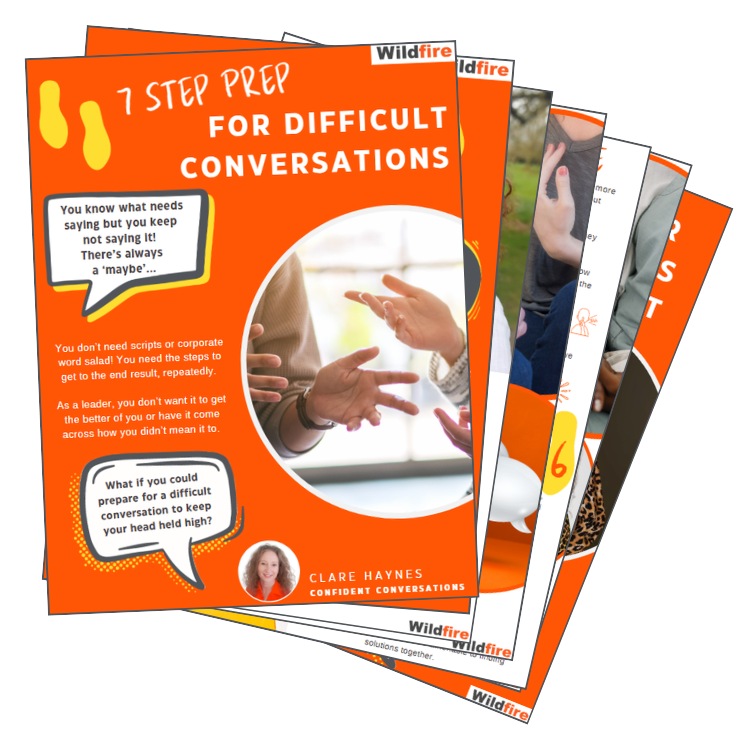
Your 7 Step Prep for Difficult Conversations Guide